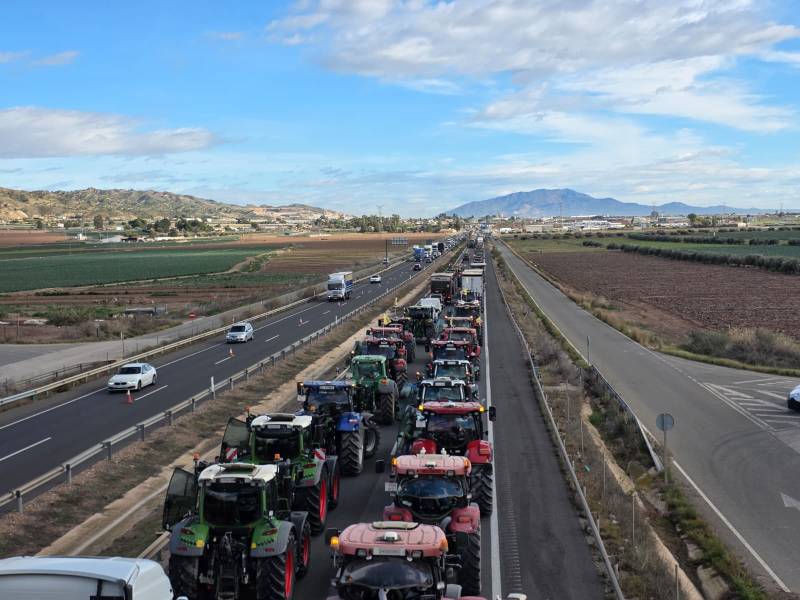
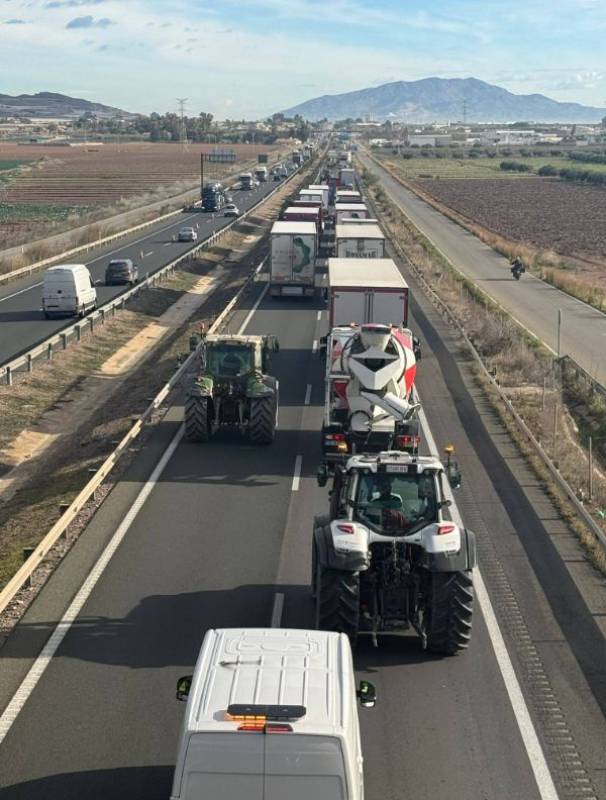
Over the course of the day, tractors and trucks rolled onto major highways in a show of force that was mirrored in 30 provinces across Spain.
Around 3,000 agricultural vehicles were involved in the Murcian demonstrations, making this the fourth major mobilisation by the sector in the past six years. Discontent has been building since protests began in Brussels a month ago in response to European Commission trade policies, including agreements with Morocco and Mercosur, as well as anticipated cuts to future Common Agricultural Policy subsidies.
Why the farmers are protesting
In Murcia, the protests focused on four key points along the A-7 and A-30 motorways. Farmers called for action to halt proposed cuts to the Tagus-Segura Water Transfer, the planned closure of irrigation wells by 2027, changes to the Mar Menor law, measures to encourage generational renewal and greater protection for the livestock sector.
Standing on a bridge over the A-7 between La Hoya and Totana, Marcos Alarcón, Secretary General of UPA Murcia, described the mobilisation as a “resounding success”.
“Now, what we absolutely need is a response from the authorities that matches the scale of this mobilisation,” he said. Among the key demands, he highlighted the need for a moratorium on aquifer closures, access to irrigation water at affordable prices and real support for young farmers.
José Miguel Marín, president of COAG Murcia, was equally forceful, urging institutions to listen to the sector’s concerns: “We see the paradigm being created for us in the European Union right now, this Brussels governance that has decided the primary sector is not strategic, that producing food is unnecessary because it will come from third parties in our country. And we will not allow this.”
Alfonso Gálvez, Secretary General of Asaja Murcia, underlined the strategic importance of agriculture in providing healthy, safe and high quality food across Spain and the European Union. He condemned what he called unfair competition from countries such as Morocco, Egypt and South Africa, arguing that current trade agreements are causing serious harm to regional producers.
What the protests consisted of
One of the most visible demonstrations took place at the Blanca crossroads, where farmers from towns such as Cieza, Jumilla and Yecla gathered before blocking the A-30 towards Madrid at around 9.45am. The protest, supported by the mayor of Cieza, Tomás Rubio, lasted throughout the morning and even took on a communal atmosphere, with participants cooking migas and grilling meat on site. According to organisers, around 230 vehicles took part.
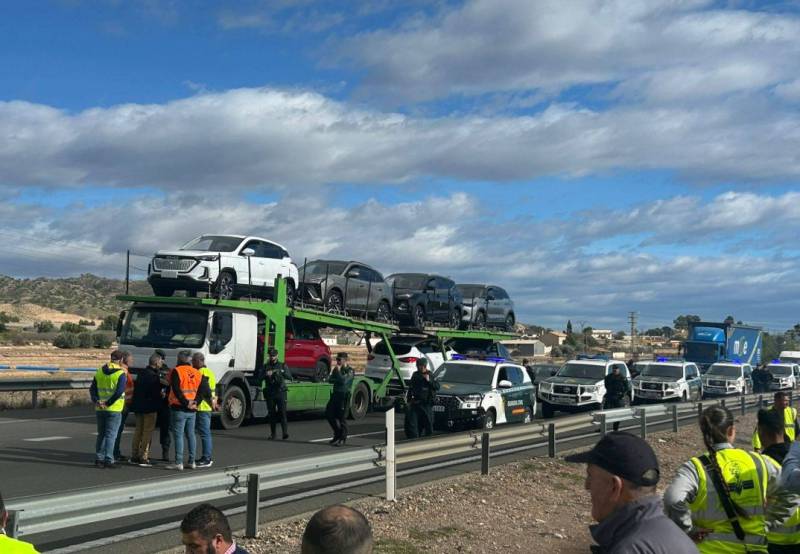
Later, farmers also briefly blocked the opposite carriageway towards Murcia, prompting Civil Guard intervention to manage traffic. The demonstration ended at around 2pm.
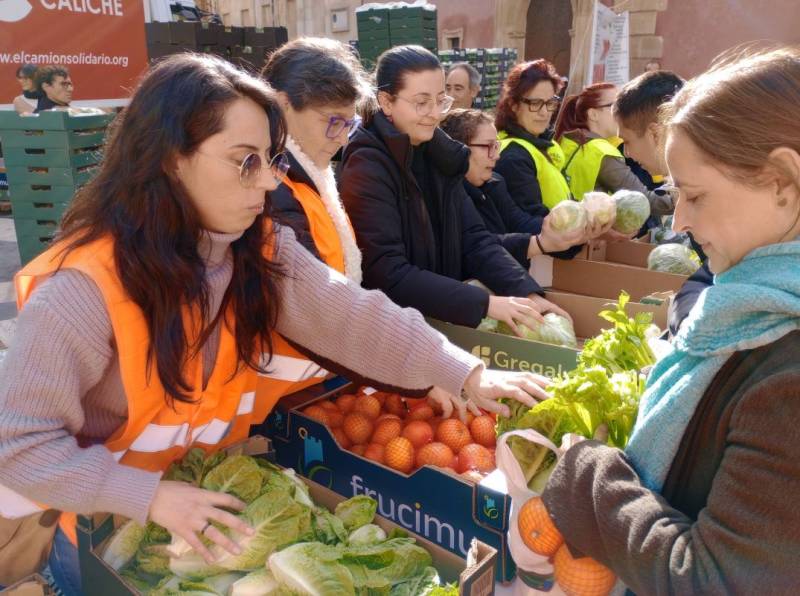
Alongside the road protests on the motorways, organisers in Murcia capital city distributed 20,000 kilos of fruit and vegetables near the cathedral to showcase the quality of local produce and to raise awareness among people of the issues they were protesting about.
Lemons, oranges, pumpkins and cauliflowers were handed out in reusable bags, with long queues forming well before the 10.30am start. By early afternoon, all 30 pallets had been emptied, bringing to a close a day that the sector described as historic for agriculture and livestock farming in the Region of Murcia.



















 One of the most visible demonstrations took place at the Blanca crossroads, where farmers from towns such as Cieza, Jumilla and Yecla gathered before blocking the A-30 towards Madrid at around 9.45am. The protest, supported by the mayor of Cieza, Tomás Rubio, lasted throughout the morning and even took on a communal atmosphere, with participants cooking migas and grilling meat on site. According to organisers, around 230 vehicles took part.