










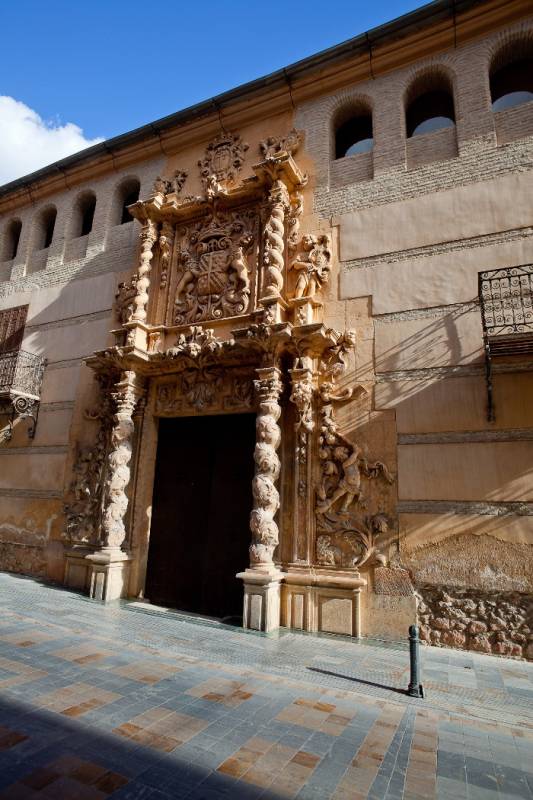
 This dramatized tour (in Spanish) of the magnificent Palacio de Guevara in Lorca is a chance to see this iconic stately home in a different way, seen through the eyes of two of the most important nobles of Lorca during the 17th and 18th centuries.
They were Juan de Guevara García de Alcaraz and his wife Isabel Pérez de Meca Ponce de León, and we encounter them on their wedding day during a period of splendour in the history of the city of Lorca. This was the baroque age, when many of the city’s most important monumental buildings were constructed, and the two main characters inform us of the history of the Ex-Collegiate Church of San Patricio, the Town Hall building, the Casas Capitulares and others.
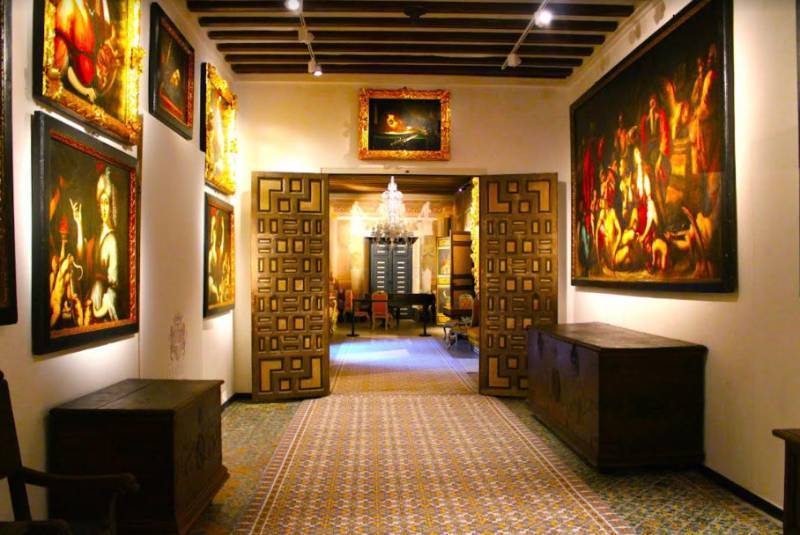 Following this, they take us on a walk through some of the main streets of the old centre and show us some of the noble houses where coats of arms can still be seen emblazoned on the façades, ending up at the most splendid of them all – their own palace, the Palacio de Guevara, a symbol of power among the ruling classes of Lorca at the time.
The tour begins at 10.00 at the tourist office in the Plaza de España and follows a route along Calle del Álamo and Calle Corredera to the patio of the Palacio de Guevara at around 11.15, after which you can complete the experience with a guided visit of the palace itself (at either 11.30 or 12.30).
No price has been set but contributions are welcomed once the dramatized visit is complete.
Prior booking is required online here, and in addition it is necessary to reserve free entry into the Palacio de Guevara online here (this costs 5 euros for adults).
Further information is available from the visitors centre in Puerta de San Ginés and Lorca castle (telephones 968 479003 / 968 959646, email info@lorcatallerdeltiempo.com or recepcion.fortaleza@lorca.net).
staff.inc.ali
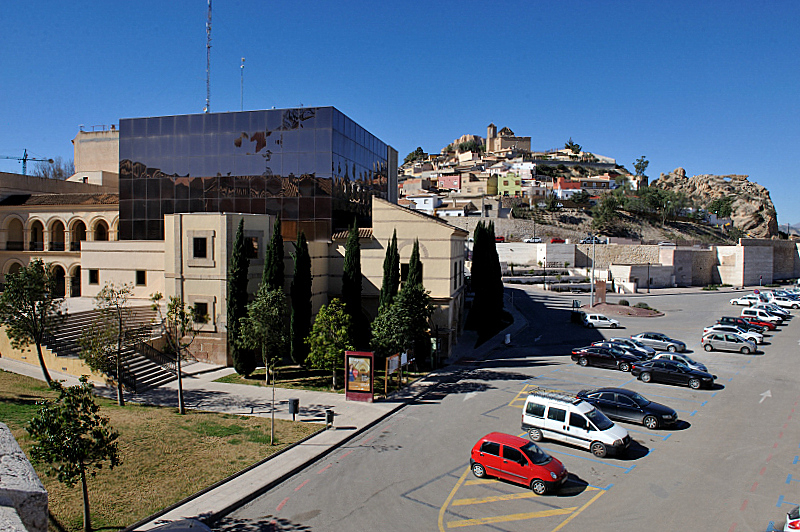
The rich and extensive history of Lorca has left a legacy of archaeological sites and historic buildings around which the modern city has built its tourism industry. Amongst these are Lorca Castle, Plaza de España, the former Collegiate church of San Patricio, the municipal archaeological museum, the Casa Huerto Ruano, the Palacio de Guevara and the churches and convents of San Francisco, San Mateo, the Virgen de las Huertas, La Merced, El Carmen and many others.
Unfortunately, Lorca has been prone to natural disaster, suffering a severe flood in 1973 which killed 50 people, and a Gota Fría on September 28th 2012, as well as a series of earthquakes, the most recent of which was 5.3 on the Richter scale on 11th May 2011 and claimed 9 lives.
 Lorca also has an area of unspoilt coastline incorporating the Parque Regional de Cabo Cope - Puntas de Calnegre, which includes the beaches of Puntas de Calnegre, Cala Calnegre and various others. Although only one is accessible by road others can be reached along dirt tracks!
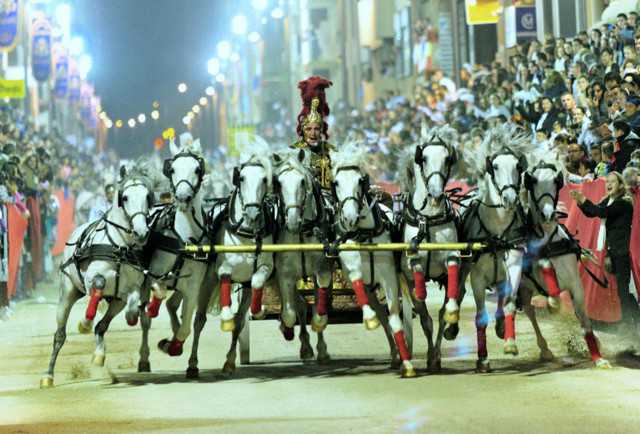
In terms of fiestas, Lorca is synonymous with Easter (Semana Santa), its biblical parades of International Tourist Interest status being famous throughout Spain. The week includes a series of parades in which the whites (Paso Blanco) and blues (Paso Azul) try to outdo each other with the magnificence of their embroideries and the skill and daring of their horsemen.
In the Autumn Lorca also celebrates the Fiestas of San Clemente and a Feria and there are a series of important events throughout the year in the Recinto Ferial, as well as a busy cultural and sporting programme.
The tourist office relocated for 14 years to Calle San Patricio, near the church, but has now returned to its former premises alongside the Palacio de Guevara in the Plaza Concha Sandoval, or Plaza de la Bordadora (click for map).
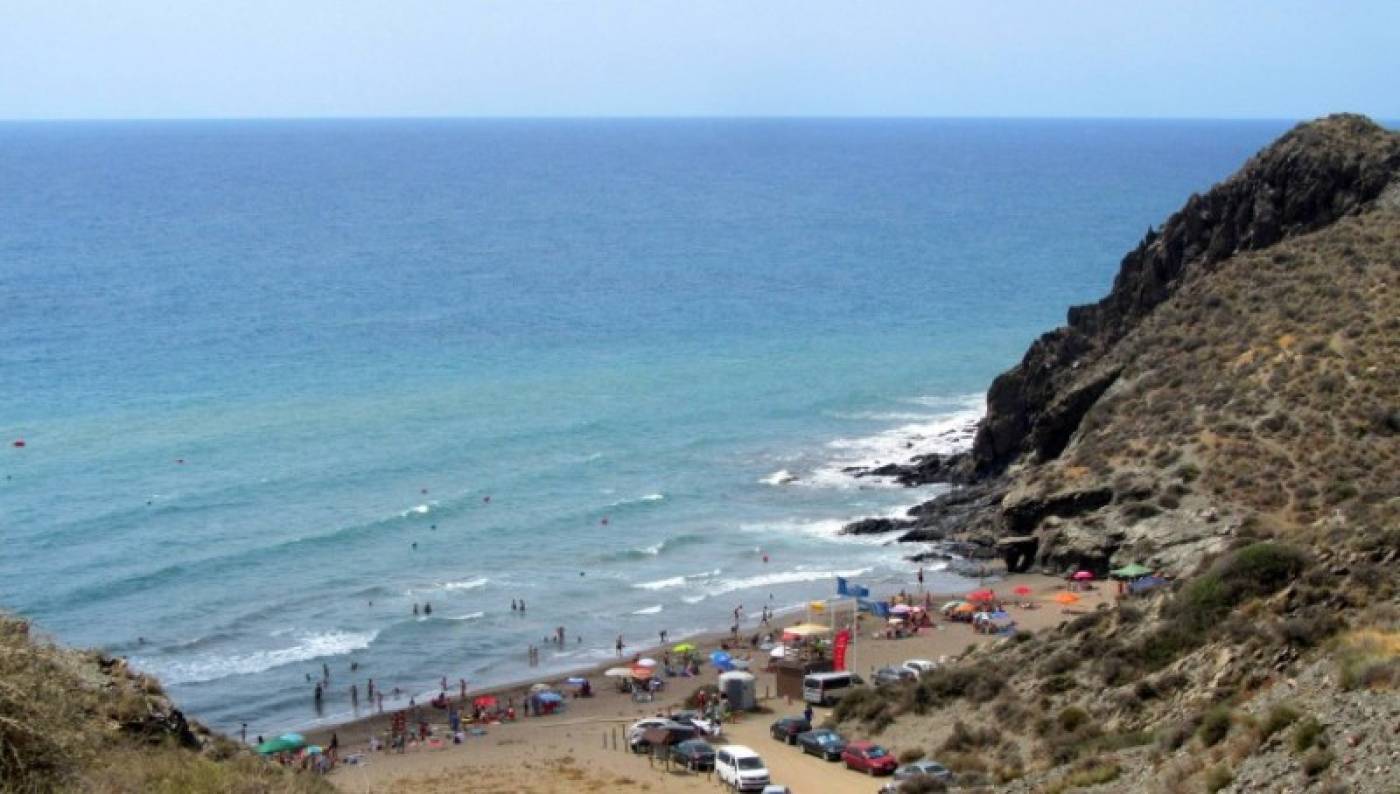 Lorca also has an area of inspoilt coastline incorporating the Parque Regional de Cabo Cope - Puntas de Calnegre, in the Sierra de Almenara, which includes the beaches of Puntas de Calnegre, Baño de las Mujeres, San Pedro, El Siscal, Cala Honda, Cuartel del Ciscar, Junquera, Cala de la Gruta, Cala Leña, Los Hierros, Cala Blanca and Playa Larga, although many are accessible only along difficult tracks or by boat!
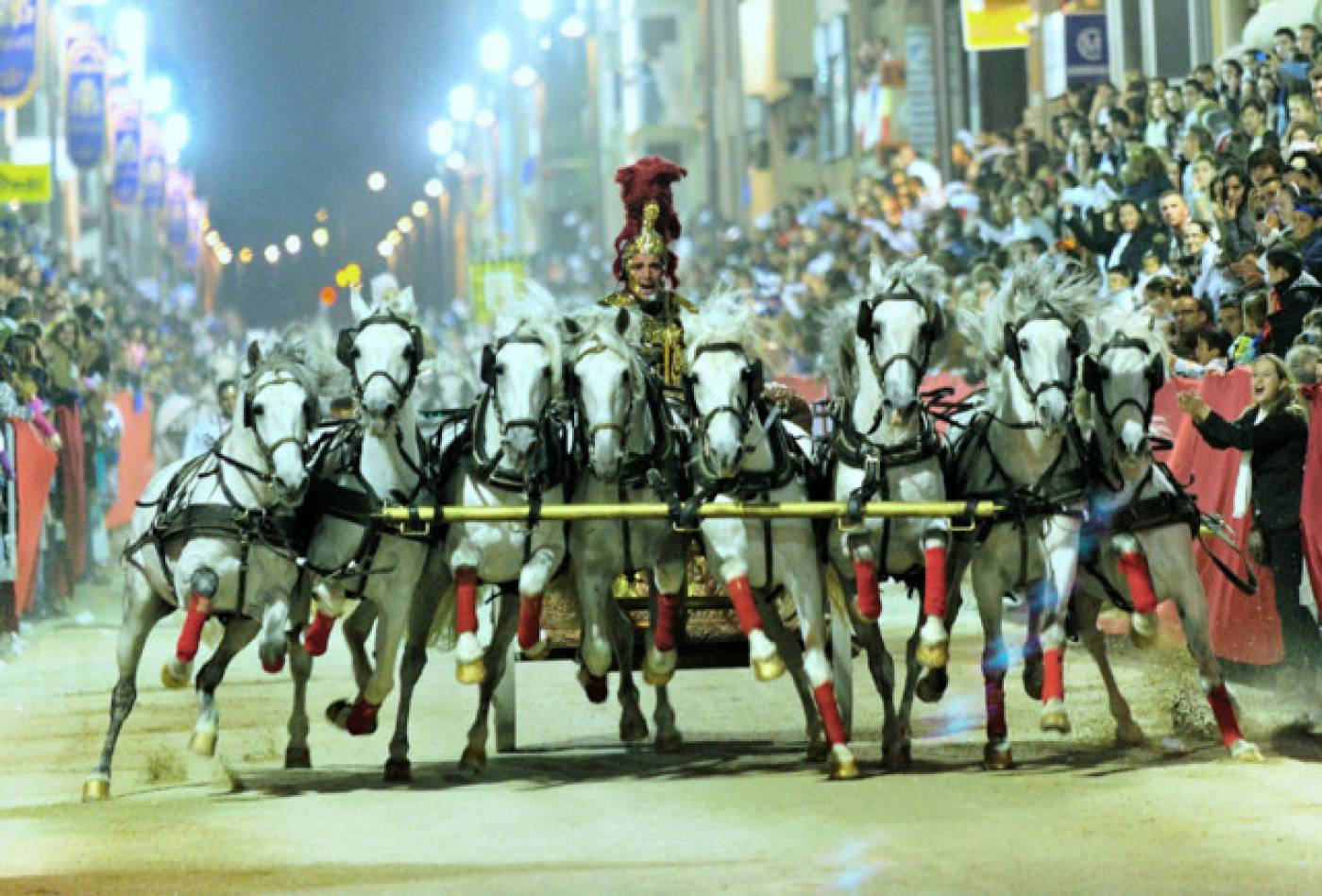 However, in spite of its many attractions, the name of Lorca is synonymous with Easter, (Semana Santa) its biblical parades of International Tourist Interest status and famous throughout Spain. The week includes a series of processions in which the Whites (Paso Blanco) and Blues (Paso Azúl) try to outdo each other with the magnificence of their embroideries and the skill and daring of their horsemen.
Lorca also has a Parador hotel, located within the historic castle.
Every day of the year apart from 1st and 6th January and 25th December, 10.00 to 14.00 and 16.30 to 18.30 (except Sunday afternoons).
These opening times are often extended and other information points created during the Semana Santa celebrations.
For more local news, events and visiting information go to the home page of Lorca Today