







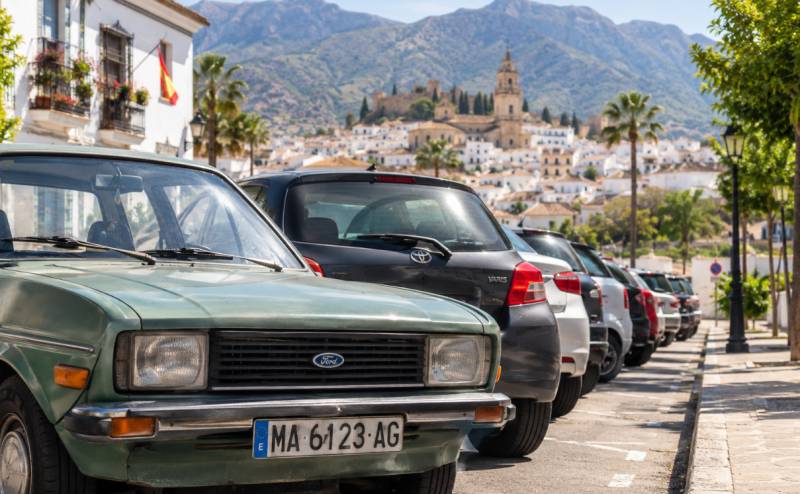









If the car parked outside your local supermarket looks like it's been around a while, you're not imagining it. According to a new report from the Spanish Association of Automobile and Truck Manufacturers (ANFAC), based on data from the DGT, the average passenger car in Andalucía is now 15.2 years old, half a year older than the national average of 14.6.
That puts the region roughly in the middle of the pack nationally. Madrid has the youngest fleet by far at 11.3 years, while Ceuta and Melilla top the list for the oldest at 17.9 years, alongside Castile and León, Galicia and Extremadura, all hovering close to 17 years.
Part of the answer lies in what people are actually buying. Across Spain, for every new car registered, 1.19 used cars over ten years old change hands. In Andalucía, that figure very nearly doubles to 2.39. ANFAC notes this has actually improved slightly compared to last year, but the pattern remains clear: Andalusian drivers are still leaning heavily towards used cars rather than new ones, which naturally slows down how quickly the region's fleet renews itself.
Combustion engines still dominate. Vehicles with a C label make up 35.4% of the Andalusian fleet, the largest single group, having grown 6.6% over the past year. Label B accounts for another 31.6%, while more than a quarter of all vehicles, 26.7%, carry no environmental label at all, though that share has dropped 6.7% since last year.
Electric and hybrid vehicles are growing quickly in percentage terms, but starting from a very low base. Fully electric cars rose 61.3% to reach 30,159 vehicles, and plug in hybrids climbed 82.9% to 34,077. Even combined, though, they only make up 1.2% of Andalucía's total fleet, well below the 2.4% national average. Madrid leads the country here with 5.7% of its fleet electrified, followed by Catalonia and the Balearic Islands.
As of the second quarter of 2026, Andalucía has 9,880 public charging points installed, though only 7,523 are actually up and running. Of those working chargers, close to 69% are the slower type, under 22kW, meaning any
one relying on public charging may still need a fair bit of patience.
Image: AI generated
staff.inc.ali
Sign up for the Spanish News Today Editors Roundup Weekly Bulletin and get an email with all the week’s news straight to your inbox
Special offer: Subscribe now for 25% off (36.95 euros for 48 Bulletins)
Read some of our recent bulletins:
Discount Special Offer subscription:
36.95€ for 48 Editor’s Weekly News Roundup bulletins!
Please CLICK THE BUTTON to subscribe.
(List price 3 months 12 Bulletins)