Granada turns its earthquake lessons into protocol and a hands-on day for the whole family
Officials race to build a shared response plan as the city invites residents to learn what to do when the ground shakes
Granada has spent the past two months living with an unsettling rhythm, the creaking, the shaking, the “when’s the next one” followed by “now what”. It’s a rhythm that began back on Saturday 15 August, when a 4.8 magnitude earthquake centred in Alhendín struck in the early hours, followed by 98 aftershocks through the night, and escalated further over the following days with additional tremors above magnitude 4 recorded across the province. Just a week ago, a magnitude 3.1 tremor served as a reminder that the activity hasn’t fully settled.
What’s different this time is the response. Authorities and technical experts have begun meeting to build a shared protocol for what happens after an earthquake strikes, aiming to avoid the confusion that followed the 2021 seismic swarm in Santa Fe, when residents were left unsure how to get their homes inspected or where to turn for help.
The first institutional meeting brought together representatives from the affected municipalities, the Andalusian Regional Government, the Granada Provincial Council, the Andalusian Council of Official Colleges of Architects (CACOA), and the Group of Volunteer Emergency Architects (GAVE). Their priority is establishing common technical criteria for inspecting and classifying buildings, along with a shared methodology for damage assessment, so residents across different municipalities aren’t met with inconsistent procedures.
CACOA president Isabel Suraña believes the recent weeks of work should translate into a stronger institutional response going forward. “Now it’s time to analyse the procedures implemented in conjunction with the administrations so that we can establish a structure that makes us increasingly stronger, anticipating emergencies so we can react very quickly,” she said.
Gonzalo Martín, coordinator at GAVE, focused on the period after the shaking stops, when residents want to know if their homes are safe and what repairs they’ll need. “The major challenge is to coordinate a response that alleviates citizens’ stress once the emergency has passed,” he said, adding bluntly that no proper protocol currently exists anywhere. “Not in Granada, not in Spain, and hardly in any administration in Europe.”
That lack of structure showed in the weeks that followed the initial quakes. By late August, the Ayuntamiento had inspected over 1,000 buildings between private and public properties, cleared seven streets back to normal use and introduced tax discounts of up to 95% to help residents with repair costs, even as 26 areas remained under monitoring. The financial toll kept climbing too, with the Insurance Compensation Consortium logging tens of thousands of claims worth well over €100 million as the seismic series eventually passed the 1,000 tremor mark through into September.
One proposal now on the table is a dedicated seismic technical committee for the Granada Metropolitan Area, a standing forum to share information, agree criteria and plan recovery work collaboratively. It remains just a proposal for now. The meeting also reviewed how the city’s buildings held up after the 2016 earthquakes, finding most damage was non structural, cracked partition walls, collapsed ceilings, detached cornices, though some cases in Las Gabias and Zaidín did require evacuations. Martín pointed to the aftermath of the 2011 Lorca earthquake, which led to proposals to demolish around a thousand homes, as a reminder of why thorough inspections matter. “That’s why preventative inspections are so important,” he said.
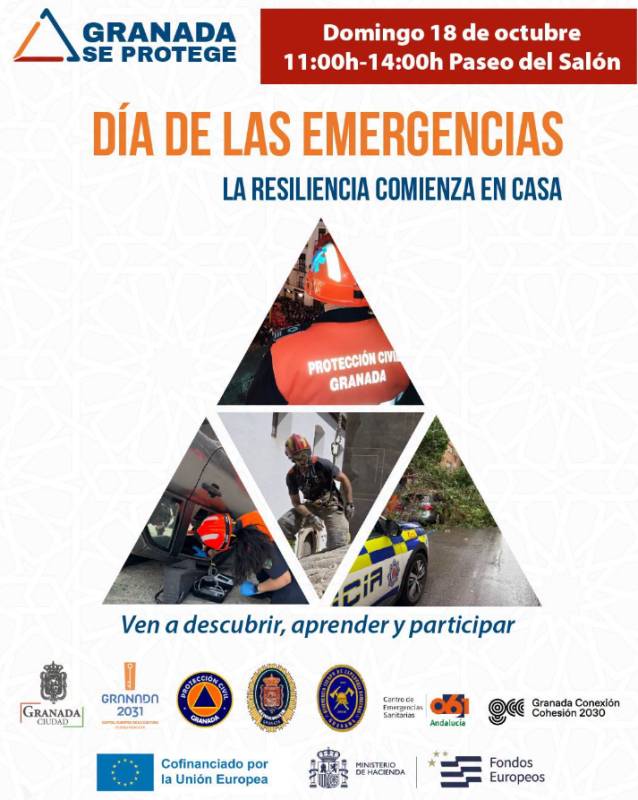
Alongside this institutional work, the Ayuntamiento is also giving residents a more hands-on way to prepare. This Sunday 18 October, Paseo del Salón hosts Emergency Day, running from 11am to 2pm under the slogan “Resilience begins at home”, part of the UN’s International Day for Disaster Risk Reduction and the city’s wider “Granada Protects Itself” programme.
Visitors can get up close with vehicles and equipment from the Policía Local, Fire Department and Civil Protection, with professionals on hand to explain how each service works. Practical first aid workshops, led by 061 and Civil Protection staff, will cover basic CPR, using a defibrillator, the Heimlich manoeuvre and the safety position. Actors will run short, interactive scenarios for children covering earthquakes, floods, fires and crowd emergencies, with specific guidance on identifying safe zones and evacuating properly during a quake. The day builds towards a multidisciplinary drill between 1pm and 2pm, simulating a vehicle falling into the Genil River, with a drone deployed by the fire service to support the rescue.
Families will receive a “rescuer’s passport” on arrival, earning a stamp at each completed activity and a “Granada Protects Itself” badge at the end, alongside a mascot, a presenter and a drawing corner for children to design their own home emergency plan.
Councillor Ana Agudo said the event gives residents a chance to meet the people who protect the city daily, and just as importantly, to learn what to do if an emergency happens. “In Granada we have experienced events such as the earthquakes of last August that have reminded us that natural phenomena are part of our reality and that, instead of living with fear, it is much better to be trained and prepared to know what to do.” As she put it, “an emergency cannot be improvised. Behind every intervention there are protocols, professionals, resources and a lot of coordination, but it is also important that citizens know their role and that together we build a more prepared and resilient city.”
















 Granada has spent the past two months living with an unsettling rhythm, the creaking, the shaking, the “when’s the next one” followed by “now what”. It’s a rhythm that began back on Saturday 15 August, when a 4.8 magnitude earthquake centred in Alhendín struck in the early hours, followed by 98 aftershocks through the night, and escalated further over the following days with additional tremors above magnitude 4 recorded across the province. Just a week ago, a magnitude 3.1 tremor served as a reminder that the activity hasn’t fully settled.