





Ermita de San Bartolomé, Cieza
The hermitage of San Bartolome, Cieza
The hermitage of San Bartolome, which is still in use today, is thought to be the oldest Christian construction 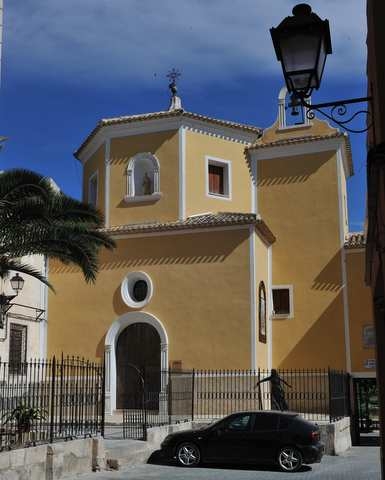 in Cieza and was built when the town was initially founded. A primitive hermitage was constructed on this site by the invading Christians of the Reconquist after the Medina Siyâsa Muslim settlement was abandoned in 1243, although it would not be until several centuries later that it would be directly linked to San Bartolome.
The church was rebuilt on several occasions following attacks on the town by Muslim forces from across the border in Granada, the last remaining Muslim stronghold in Spain.
Over the years the hermitage was abandoned, documents from the 16th century showing that it was even used as a refuge for sheep. Following the visit of Emperor Carlos V in 1541, who stopped to pray in this hermitage, one of the most important reconstructions was undertaken.
In the 16th century San Bartolome was selected to be the patron saint of Cieza, and the Hermandad de San Bartolomé was created to take responsibility for all celebrations and worship associated with the patron saint.
As part of this process, in 1681, the church was rebuilt using the remains of the old hermitage.
At this point in time, the image of San Bartolomé was housed in the church of Santa María ( now La Asunción) and the tradition of transferring the image on 25th April each year from La Asunción to the hermitage where it would stay until 15th August, when it would be returned back to Santa María began.
About 1714 the hermitage was remodelled but it took several decades before it became a suitable place of 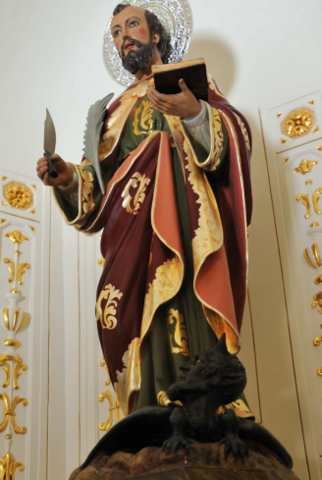 worship for the patron saint. In 1790, the image of the saint was transferred back to the hermitage on a permanent basis.
Architecture: The hermitage of San Bartolome is built in a simple style both internally and externally. It is made up of two superimposed sections. The lower section comprises one chapel with an arched entrance and simple al fresco paintings by Lorquian painter Muñoz Barberán which allude to the martyrdom of the saint. The altarpiece was built after the civil war in sympathy with the simple lines and austerity of the rest of the building.
The upper section built in an octagonal shape is the “conjuratorio” and houses a recess with a stone image of the patron.
Conjuratorio: The Conjuratorio (conjuratory or exconjuratory) of the hermitage of San Bartolomé in Cieza and the Conjuratorio Real Alcázar-Santuario of Santa Cruz of Caravaca are the only two remaining examples in south eastern Spain of this type of construction.
The Conjuratorios ( which literally means conjurers) were used to ward off adverse climatological events and were frequently found at this period in time. Agriculture was an essential part of the daily survival of farmers and these structures were often attached to hermitages as the focal point for specific ceremonies to bless the land and pray for help in situations of climatological adversity.
The interior is decorated with XIX century al fresco popular paintings of vegetation based on floral vases and garlands. On the vault is the scene of the storm with a great cloud with lots of lightening.
The statue of San Bartolomé: The historical statue of San Bartolomé dates back to the 16th century and is attributed to sculptor, Juan Pérez de Artá, from Granada, being characteristic of his work. It is made in a late Gothic style, in an idealized style, with strongly expressive eyes and a beard. During the Civil war it was destroyed and thrown into the river, and only the head was recovered. The image was reconstructed in 1943 by the sculptor Manuel Juan Carrillo Marco, from Cieza, using the original head.